ServicesLighting Installation
Lighting Installation for Forest Hill Homes
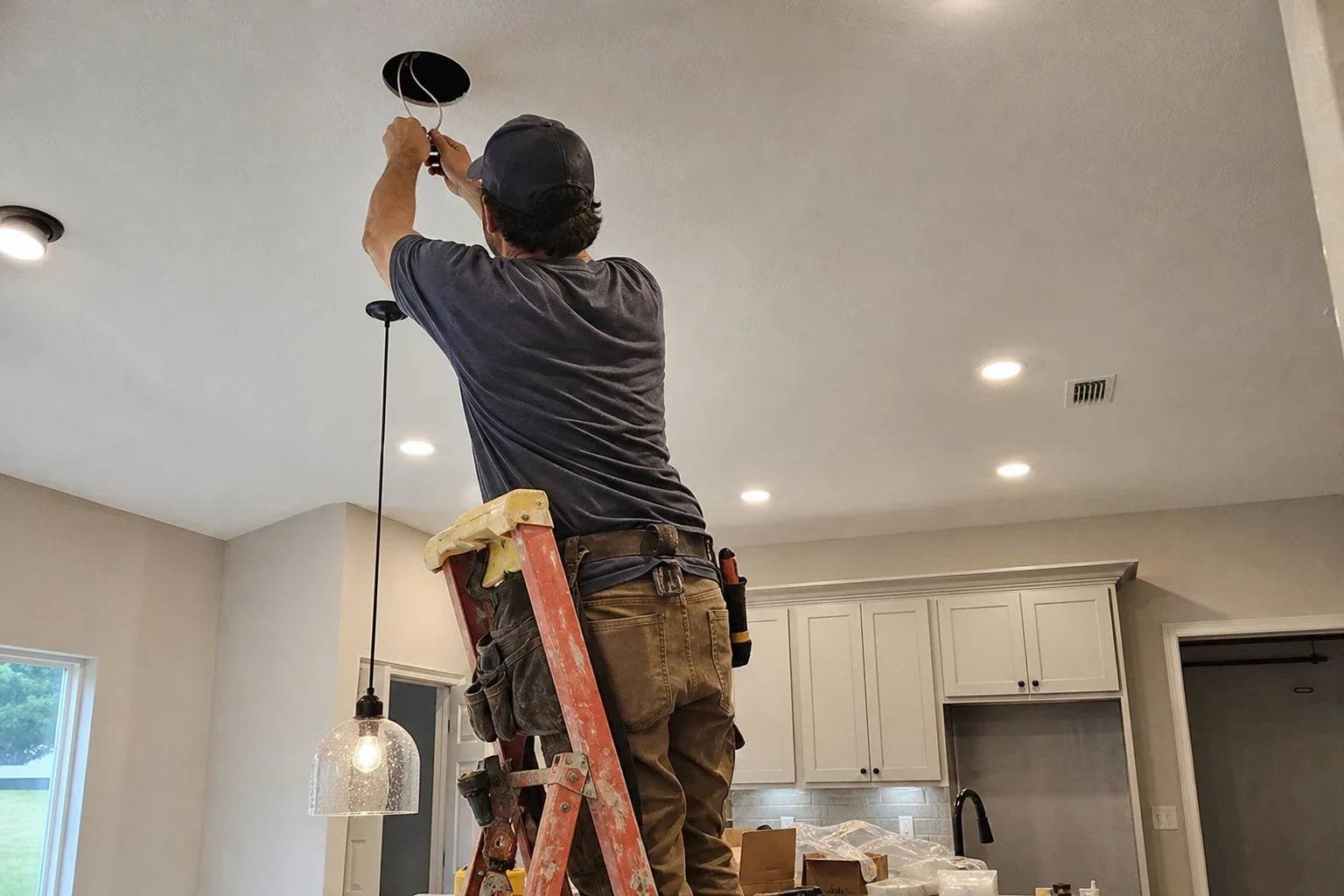
Recessed lights, ceiling fixtures, fans, under-cabinet strips and outdoor lights, each paired with the box, rating and dimmer its spot calls for. We cover your floors, step around the beds outside, and tell you what we will cut or run before any work begins.
Light That Works the First Time, Installed Without a Mess
Good lighting installation is mostly about the parts you never see: a ceiling box rated for the weight hanging from it, a housing rated for contact with insulation, a dimmer that matches the LED driver, and a fixture listed for damp or wet locations when it lives outside. Get those right and the light runs quietly for years. Get them wrong and you see flicker, buzzing, tripped GFCIs or a fan that wobbles loose.
We plan each fixture around the framing, the existing circuit and how you use the room. Before a hole is cut, we show you where it goes and why. Drop cloths go down under every ladder, and outside we keep cable runs and trenches out of your beds wherever the route allows.
Fixtures and Controls We Install
Recessed cans and LED wafers
Spacing follows the joists and how you actually use the room. Where insulation sits on top of the ceiling we use IC-rated housings; where clearance is tight, slim LED wafers mount in a smaller cutout with no can above, so there is less drywall to patch.
Fixtures, fans and chandeliers
Anything heavy or moving gets a box and brace listed for it. A ceiling fan hung from a plastic light box is a common cause of wobble and loose connections, so we replace the box rather than hope it holds.
Dimmers and switching
We pair dimmers to the fixtures you choose, since many LED drivers want a trailing-edge or ELV dimmer to avoid flicker and hum. We also add three-way switching and check for a neutral in the box before installing smart switches.
Under-cabinet and accent lighting
Low-voltage LED tape and puck lights need a properly sized driver mounted where it can shed heat and be reached later. We hide wiring inside cabinets, not across the backsplash.
Outdoor and landscape lighting
Porch lights, motion floodlights and path lights get wet-location fixtures, GFCI protection where required and in-use covers on exposed receptacles. Landscape transformers are sized to the total wattage so the last light on the run is as bright as the first.
Signs It Is Time for New Lighting
- LEDs flicker or buzz
- This usually means an old incandescent dimmer is driving LED lamps it was never designed for. Swapping the dimmer often fixes it, and we confirm the match before we leave.
- Dark kitchens and work areas
- One center fixture throws your shadow onto the counter. Recessed lights placed over the front edge of the counters, plus under-cabinet strips, put light where your hands work.
- A fan that wobbles or hums
- Wobble often traces back to a box not rated for fan support, or a loose mounting bracket. Both are worth correcting before the screws work further loose.
- Dark entries and side yards
- A motion floodlight on the driveway or a pair of path lights along the walk makes coming home after dark safer, and it is simple to add when an exterior circuit is nearby.
- Fixtures that run hot or discolor
- Browned glass, brittle socket wiring or a scorched ceiling ring point to an overlamped or failing fixture. If the wiring behind it is damaged, our Electrical Repair work handles that first.
How a Lighting Job Runs
- 1
Walkthrough and layout
We look at each room, check the attic or crawl access, and test the circuit you plan to use. Then we mark fixture locations and explain the wire route so nobody is surprised by where we cut.
- 2
Protect the house first
Drop cloths go under ladders and along the path we walk, and furniture gets covered or moved with your okay. Ceiling cutouts are made with a hole saw and a dust shroud to keep drywall dust off your floors.
- 3
Wire, mount and set controls
We run cable, install rated boxes and housings, hang fixtures and connect switches or dimmers. Outdoors, we route cable and trenches around plantings and set the soil and sod back when we close up.
- 4
Test, clean and walk you through it
Every light is tested on its full dim range, GFCIs are tripped and reset, and motion sensors are aimed and timed. We vacuum up, then show you each switch and anything you will want to know later.
What Goes Into the Price of New Lighting
Lighting work is usually priced by how many fixtures you want and how much effort it takes to get wire to each. Hanging a light on a box that is already there goes fast; adding one to a finished ceiling needs more planning. When you book, we walk you through what sets your price before anything starts.
- Replacing a light or adding a new one
- Putting a fixture on a sound, properly rated box already in place is quick work. A light where no wiring runs today means fishing cable through finished walls and ceilings, which takes longer.
- Getting into the attic and ceiling
- Recessed lights go in easily under an open attic with space to work. Low-pitched roofs, upstairs rooms and vaulted ceilings add time and can call for small access openings that we patch afterward.
- Capacity on the existing circuit
- Before adding lights, we check how much load the circuit already has. If the new fixtures would overload it, a separate circuit makes more sense, and if the breaker box is out of open spaces, we tell you directly. At that point Panel Upgrades becomes part of the talk.
- Outdoor run length and digging
- How far the wire travels to a post light or landscape zone, and what lies along the way, drives much of an outdoor job's cost. The fixtures, transformers and controls you pick play a part as well.
- Permit requirements
- Depending on how big the job is and what the local jurisdiction asks, lighting work may need a permit and inspection. If yours does, we take care of it and it is part of the price.
Common Questions About New Lighting
- Will you hang fixtures I bought myself?
- We will. Give us the model number or have the box ready at the visit, and we will check its weight, how it mounts and whether it works with a dimmer. If it is not rated for the spot you have in mind, like an indoor fixture on an open porch, you hear about it before we put it up.
- What makes new LEDs flicker on a dimmer?
- The usual cause is a dimmer that does not match the LED driver, or a total wattage too low for the dimmer's minimum. We look up the fixture's list of compatible dimmers, install one built for that load, and run it from the lowest setting to the highest.
- How much ceiling gets cut for recessed lights?
- Every light gets one opening sized to the fixture, and the trim hides it. If the attic does not give us access, a few small holes between lights may be needed; we mark them for you first and use as few as the framing permits.
- Can you swap a ceiling light for a fan?
- In most cases, provided we put in a box listed to carry a fan and fasten it to the framing. For separate switches on the fan and its light, we see if the cable already there has enough conductors or pull a new one.
- Does outdoor lighting work tear up the yard?
- Together we pick a route that misses beds and roots. The sod comes up in a clean strip and sits to the side, then goes back down and gets watered in. Summer heat makes same-day replacement matter, so trenches are closed before we leave.
- Is a permit needed for lighting work?
- A plain fixture swap often needs none, while new circuits or bigger projects usually do. It comes down to the scope and the local jurisdiction, and we tell you which case yours is. Lighting within a larger project falls under Remodel & Addition Wiring.
Plan Your New Lighting With Us
Tell us which rooms or outdoor spots you want to light and we will set up a visit to lay it out. We serve Forest Hill and nearby towns like Kennedale, Everman and Fort Worth.