ServicesEV Charger Installation
EV Charger Installation in Forest Hill
We give your Level 2 charger a dedicated 240-volt circuit sized to the charger's rating and to the spare capacity your panel really has. The load math comes first, then a neat wire route, covered floors wherever we walk, and a check that your car is charging before we leave.
A Charger Circuit Built for Hours of Steady Load
A Level 2 charger is different from most things in your home. It pulls close to its full rating for hours at a time, often overnight. Code classifies that as a continuous load, which means the breaker and conductors must be rated for 125 percent of the charger's draw. In practice, a 48-amp setting goes on a 60-amp breaker, and a 40-amp setting goes on a 50-amp breaker. Undersize either one and you get nuisance trips, a receptacle that runs hot, or worse.
Before any wire is pulled, we look at what your panel already carries: the air conditioner, range, dryer, water heater and everything else. That load check tells us whether your charger fits as is, needs a lower amp setting, or calls for load management or a panel upgrade. You hear the answer and the reasons before we start, and we tell you which rooms and parts of the yard we'll need to work in.
What the Installation Includes
Load calculation on your panel
We total your existing loads and compare them to your service size. This decides the charger's amp setting, not a guess based on what the box says.
Dedicated breaker and correctly sized wire
Each charger gets its own two-pole breaker and copper conductors rated for that breaker. Where a receptacle is used in a garage, we install the GFCI protection code calls for.
Plug-in or hardwired connection
We can mount a NEMA 14-50 receptacle for a plug-in unit or hardwire a wall connector directly. Hardwiring removes the receptacle as a heat point and lets most units run at their highest setting.
Planned wire route and conduit
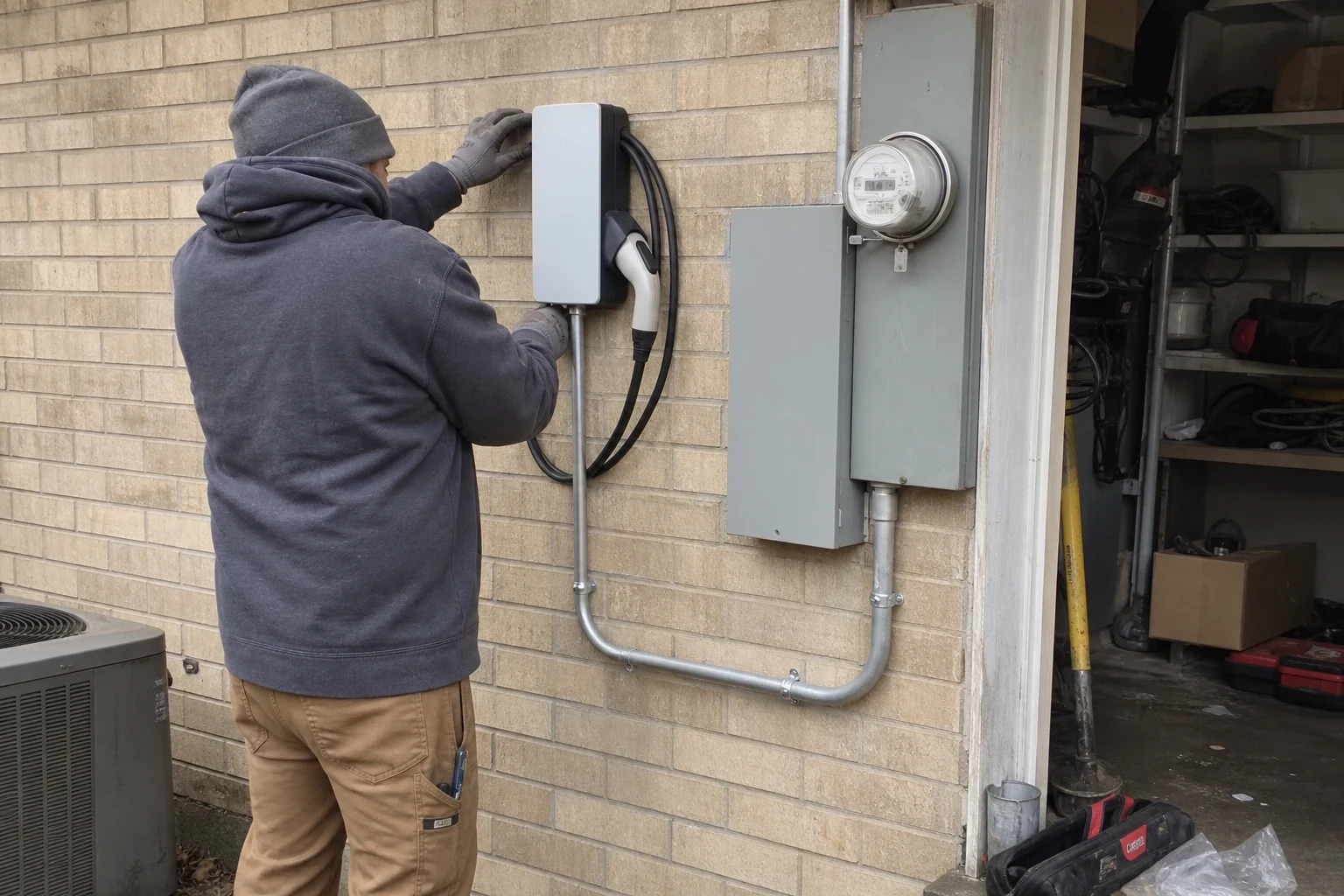
We run cable through the attic or wall where we can, and use EMT conduit on exposed garage walls. Outdoor runs get wet-location fittings and a rated enclosure.
Permit, inspection and testing
We pull the permit and line up the inspection the way the local jurisdiction requires. After that, we put the circuit under real load with your vehicle plugged in.
When a Level 2 Charger Makes Sense
The car isn't full by morning
A standard 120-volt outlet adds range slowly, just a few miles per hour plugged in. If you keep starting the day below full, a 240-volt circuit makes up the difference.
Charging trips the breaker
Most often the car shares its circuit with a freezer, the garage door opener or shop tools. Giving the car its own circuit ends the conflict.
The plug runs warm or the outlet is discolored
Heat there means a loose connection or a tired receptacle that can't take steady draw. Quit using it and get it inspected.
An extension cord is in the mix
Few cords are built for hours of constant current, so their connections get hot. Charging gear belongs on a correctly rated outlet or wired in directly.
Your EV will be delivered soon
Scheduling the load check ahead of delivery leaves time to work out any panel limits, so the car charges right from night one.
How Your Install Day Runs
- 1
Phone call and scheduling
On the call, give us the charger make and model, where the panel is mounted and which spot the car usually sits in. From there we pick a visit day that fits around your household.
- 2
Load check and route plan
We open the panel, read the service rating, total the loads and walk the route from panel to parking spot. You get a plain explanation of the circuit size, wire path and any limits we found.
- 3
Installation with your home protected
We lay drop cloths along any indoor path, wear shoe covers inside, and cover the panel area. If a run goes outside, we cut and set aside sod or mulch and put it back when the work is done.
- 4
Inspection and live test
Once the inspector signs off as required, we plug in your car, confirm the charge rate in the charger's app or display, and check the breaker and connections for heat. Then we sweep up and show you where the breaker is labeled.
What Drives the Price of a Charger Install
We price each install from your panel and where you park instead of quoting one flat figure. The largest differences come from the length of the wire run and whether the panel can take on the new load. You hear about every item before we start, so you know the scope up front.
- Charging amperage
- A higher setting calls for a bigger breaker and thicker copper. Setting the charger at 32 amps rather than 48 can sometimes keep you from needing a panel upgrade.
- How far the wire runs
- A panel inside the garage or on the wall just behind your parking spot means only a few feet of wire. A detached garage or a charger post near the driveway can require a trench and buried conduit.
- Room in the panel
- When the load check shows the panel is out of room, we talk through a load management device or our Panel Upgrades service. Either one changes the scope.
- Plug-in or hardwired
- A 14-50 receptacle means adding the device and a GFCI breaker, while a hardwired unit connects directly. Your charger's manual often settles which one fits.
- Permit and inspection steps
- The fees and inspection steps vary by local jurisdiction, and we cover them when we explain the scope.
Common Questions About Charger Installs
Something not covered here? (682) 281-8982
Is the garage wall a good place to mount my charger?
For most houses it's the best spot. The wall is dry, protected and close to where the car already parks. We set the mounting height and side so the cable meets your charge port with slack to spare, instead of lying across the slab where it gets driven over. A panel on the same wall or nearby keeps the circuit short and the cost down.
Will I need a panel upgrade?
Not always. The load calculation tells us whether your service can carry the charger along with your AC, range and dryer. If it's tight, a lower amp setting or a load management device may work, and if not, we'll explain what a panel upgrade involves.
Should I get a plug-in or hardwired charger?
Plug-in units are easy to take with you if you move. Hardwired units avoid receptacle wear and often allow a higher charging rate. We'll look at your charger's specifications and your circuit before recommending one.
Who handles the permit for the new circuit?
We do. Pulling the permit is built into the job, and we book the inspection in whatever way the local jurisdiction requires. If the inspector wants details about the breaker size or wire gauge, we answer those questions directly.
Can the charger go outside near the driveway?
It can. We use a unit rated for outdoor mounting, wet-location conduit fittings and a weatherproof cover. Where the route passes through lawn or a flower bed, we lift the sod or plants, lay the conduit, and set everything back so you aren't left with a bare strip across the yard.
Get Your Charger Running at Full Rate
Tell us your charger model and where you park. We'll book a service visit to check your panel and plan a clean, tidy install.